

Alfa Abdulkadir‘s work is steadily leaving an imprint on the Nigerian art and design landscape. As Lead Designer at Retro Africa, a contemporary art gallery…
Alfa Abdulkadir‘s work is steadily leaving an imprint on the Nigerian art and design landscape. As Lead Designer at Retro Africa, a contemporary art gallery based in Abuja, Alfa has spent the past few years shaping visual environments that enhance the experience of art itself. His approach is thoughtful, multidimensional, and grounded in a quiet but purposeful exploration of emotion, memory, and the unseen.
Trained in Milan, Alfa merges formal design principles with a deeply personal artistic practice that spans sketching, sculpture, and storytelling. His recent debut solo exhibition, Beneath Skin, marked a turning point: the moment he stepped beyond design and into the foreground as an artist in his own right. The show brought together pen drawings, sculptural forms, and a series of recurring motifs—hearts, organic shapes, and imagined characters—to explore internal experiences often left unspoken.
The Lane is an interview series with emerging voices in Africa’s culture ecosystem. Here, Alfa Abdulkadir shares with Haneefah Abdulrahman on the evolution of his practice: from childhood sketches to building imagined worlds through 3D design tools, to working alongside curators and artists at Retro Africa. He shares how emotion fuels his process, why storytelling matters, and what it means to create work that invites introspection rather than answers. For those just encountering his work, this is an entry point into a practice defined not by spectacle but by depth, restraint, and reflection.
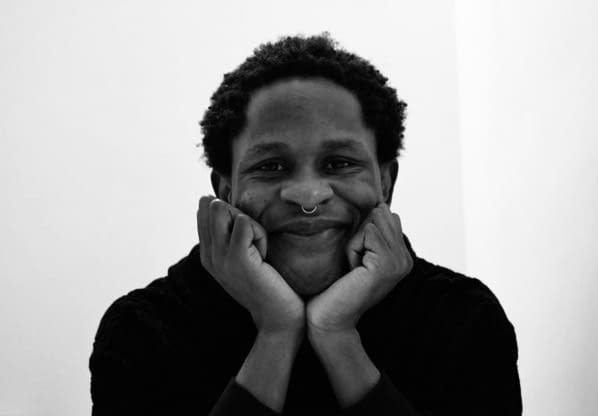

Haneefah Abdulrahman: Could you remember the first time you drew and sculpted? How did you feel painting and sculpting for the first time, and what prompted it?
Alfa Abdulkadir: As a child, I have memories of sketching dinosaurs with my father. That might be my earliest encounter with art practice. I think the realisation and subsequent feeling of being able to take something from your imagination and translate it into physical reality is a strange but profound experience: turning thoughts into form.
Haneefah: How did you start out as an artist, and how did you develop your craft? Take us through your journey and highlight key moments that shaped your artistic path.
Alfa: I still hesitate to call myself an artist in the full sense of the word. But I’ve always been creatively inclined, prone to sketching characters, building imaginary worlds and concepts, and later translating these into digital spaces using 3D tools that now form a core part of my process. A pivotal moment in shaping this path was working with Retro Africa and Dolly Kola-Balogun. Working with her and her team gave me a new lens on what it means to create with purpose.
Haneefah: Who are some of your favourite artists or biggest artistic influences?
Alfa: Some people have inspired me to take this path more seriously—artists like Ken Nwadiogbu, Yusuff Aina, and Ayanfe Olarinde. Stylistically and narratively, I’m drawn to the works of Egon Schiele, Kevin Finney (Blindfish), Sang Woo Kim, and Moebius. Then there are artists like Daniel Arsham, whose fusion of design and art is something I aspire toward in my own way. Tejumola Butler is another name in that space. So yes, there are quite a few layers of influence.
Haneefah: What does art mean to you?
Alfa: Art, for me at this point in my life, is an outlet. It’s a creative language, a way to express ideas, emotions, and thoughts I often struggle to articulate with words. It gives form to what would otherwise remain internal.
Haneefah: What was the journey like preparing for your debut solo show, Beneath Skin? How did you develop the concept, and what significance does the title hold for you?
Alfa: It was challenging. It was the first time I decided to take art seriously, to commit to building a full body of work. There were a lot of moments of trial and error, learning through doing, and figuring out new ways to both create and present. The physical aspects came quite naturally and intuitively, though; I knew from the start that I wanted the presentation itself to be artistic. In terms of the conceptual aspects, I was trying to highlight personal things that I experienced as a young adult that were difficult for me to express, even though I knew these things were, to an extent, universal experiences and feelings. This was a way for me to express them—bringing them from underneath the skin to the surface.
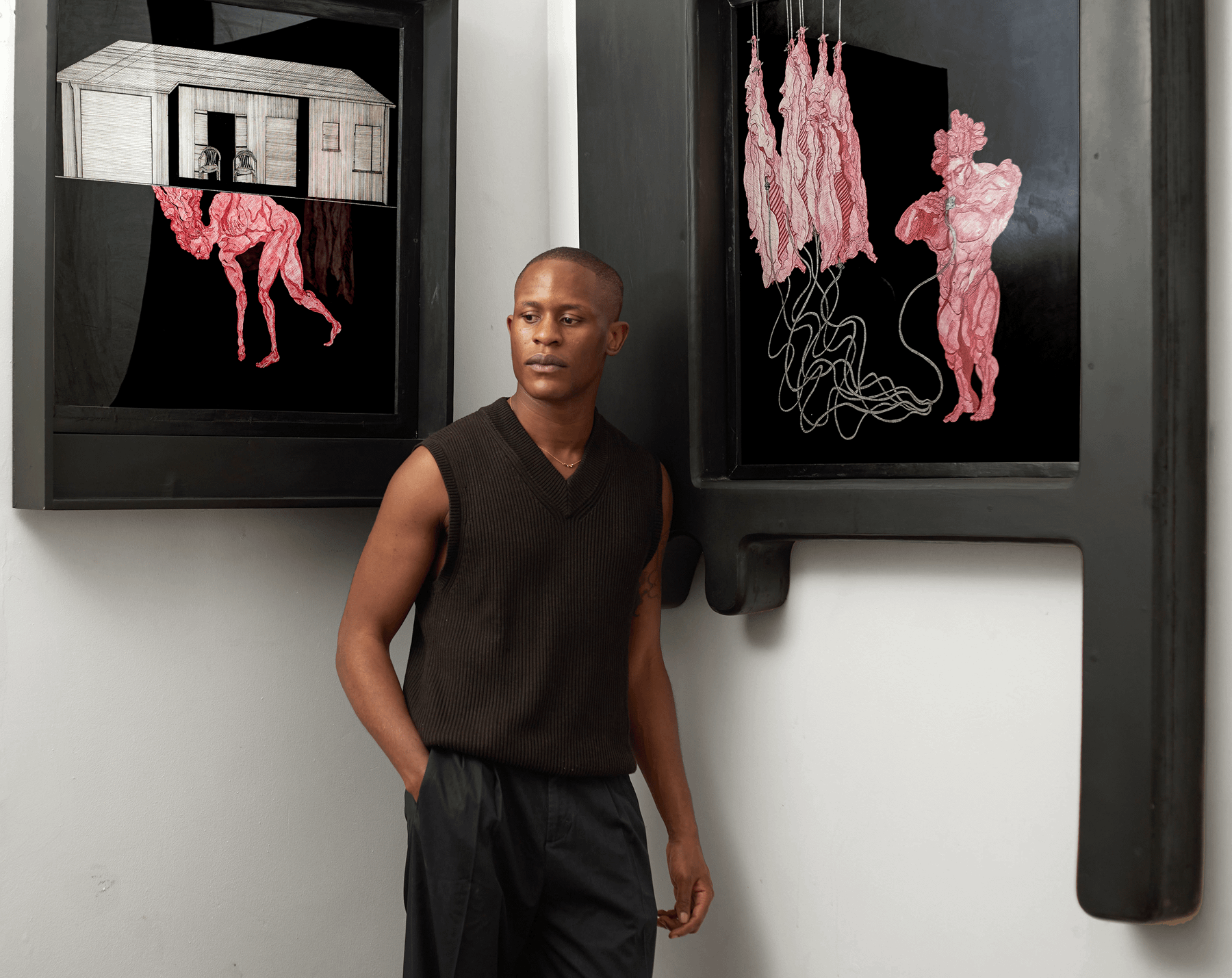
Haneefah: When I attended your debut solo exhibition at Windsor Gallery, I was totally engulfed in your artworks; they were all sorts of imaginative creations crafted out of reality. What is the process of your fusions of reality and imagination?
Alfa: I’ve always been drawn to stories, whether crafted by authors, animators, or directors. That sense of world-building deeply inspires me. I try to translate that into my work: constructing pieces that feel like fragments of a larger universe. Each artwork exists on its own but is also tethered to a deeper narrative.
Haneefah: Your artworks, the ones drawn with pen, give the heart shape in their different forms and perspectives. I call that creation “The Shapeshifting Hearts”. What inspired the creation, and what do they represent to you?
Alfa: Shapeshifting Hearts is a very interesting analogy—I like it. There are two recurring elements in those characters. One is the colour red, which for me symbolises life, vitality, and intensity. The other is the organic growth on their heads, a visual metaphor for their personality or internal world. I don’t know what the inspiration is, to be honest; I just found myself using these colours and adapting these forms as time went by. Now it’s a key staple of my artwork.
Haneefah: What role does storytelling play in your artistic expression, particularly with the use of ink in your art?
Alfa: It plays a significant role. I’d say it helps me—and I guess viewers as well—empathise with the artwork. The ink I use has nothing to do with storytelling, particularly; it just happens to be a medium I’m quite familiar with and comfortable with.
Haneefah: What’s your thought process when selecting colour combinations and mediums for your works?
Alfa: I work mostly in monochrome, so colour isn’t something I dwell on deeply. When it comes to materials, I experiment and look for things that complement, align or resonate with the subject or other mediums present and allow for a certain rawness or contrast. It’s more intuitive than calculated.
Haneefah: How do you balance the darkness and intensity of your emotions with the rhythm of existence in your art?
Alfa: I don’t have to, in fact. It helps me deal with these emotions when I have to sit with them for so long and express them in a creative way. It’s almost like some kind of therapeutic release sometimes.


Haneefah: What message does your art convey about the human experience, and how do you hope it resonates with viewers?
Alfa: Right now, I’m interested in the unspoken—the collective but often invisible things we all feel. My work is an invitation to reflect, to pause, to acknowledge those things we often avoid or suppress. It’s an avenue and invitation to reflect and engage on these topics, and I guess ultimately to feel less alone in some profound thoughts and feelings.
Haneefah: If you had to choose between sculpting and drawing, which one would you prefer and what would influence your decision?
Alfa: Sketching. It’s my most natural mode of expression and the core of my practice currently. The sculpting (wood carvings) is something new to me and secondary. I collaborate with artisans to bring parts of those ideas to life, and just like the wooden sculptures, there will be other secondary elements I’ll continue exploring in future works.
Haneefah: Do the demands of constant creativity ever feel overwhelming, or do you find ways to manage the pressure?
Alfa: The creative demands themselves aren’t overwhelming, for now at least. What is challenging, however, is balancing other aspects of life, especially work, with my artistic practice. For this, I have learned to schedule time a bit more effectively to deal with it.


Haneefah: What’s the hardest decision you have ever made as a human and an artist?
Alfa: That’s a difficult one. One of the hardest decisions I’ve made that I can remember as a human, I guess, is moving back to Nigeria. As an artist, I haven’t made any particularly tough decisions yet. Maybe in a couple of years I’ll get back to you on that one.
Haneefah: How much impact have your artworks had, considering your vision when you started out?
Alfa: That’s hard to quantify. I’m still figuring it out. I think I’ve only just begun to scratch the surface of what I want to do and say, but seeing people respond to the work and engage with it has been surreal.
Haneefah: How satisfied are you with what you have achieved so far?
Alfa: I’m grateful I’ve finally begun the journey. I cannot thank Windsor Gallery and Richard Valdago enough. But I’m far from satisfied. There’s so much more I want to articulate—more concepts, narratives, and ideas I want to bring to life in ways that resonate globally.
Free · Weekly · Unsubscribe any time

Maame Blue is Searching for More Humanity
Every creative has a story that brought them here. First-person interviews with creatives across industries. Each issue is in partnership with, and guest-curated by a different organization.
Read the full series →


Comments
No comments yet — be the first to share your thoughts.